How to Bypass Aggressive Anti-Bot Protection in 2026: Complete DataDome, Kasada, Akamai & Cloudflare Guide
Master anti-bot protection bypass in 2026. Defeat DataDome, Kasada, and Cloudflare Turnstile using TLS JA4 matching and residential nodes.

TL;DR: Modern anti-bot mitigation systems in 2026 (DataDome, Kasada, Akamai Bot Manager, Cloudflare Turnstile) no longer rely on simple user-agent or IP rate limiting. They evaluate client authenticity across four synchronized layers: Network/TLS Fingerprinting (JA3/JA4, HTTP/2 frames), Runtime Environment Integrity (WebGL, Canvas, AudioContext, Prototype chains), Behavioral Dynamics (Bio-realistic Bezier mouse curves, keystroke entropy), and IP Reputation (Datacenter vs Residential ASN). This guide details how each system works and provides working Playwright stealth implementations to bypass aggressive anti-bot protections.
The Modern Anti-Bot Landscape: 4 Major Threat Engines
Modern enterprise web applications deploy specialized Web Application Firewalls (WAFs) and bot mitigation platforms. Here is how the four industry leaders evaluate incoming automation traffic:
┌─────────────────────────────────────────────────────────────────────────────┐
│                   Multi-Layer Anti-Bot Inspection Stack                     │
├─────────────────────────────────────────────────────────────────────────────┤
│ 1. TCP/TLS Handshake Layer    ──► JA3 / JA4 Fingerprint, TLS Extensions     │
│ 2. HTTP/2 Framing Layer       ──► Pseudo-Header Order, Window Size, Settings│
│ 3. Client Sensor Scripts      ──► Canvas, WebGL, AudioContext, navigator    │
│ 4. Behavioral Biometrics      ──► Cubic Bezier Trajectories, Scroll Rhythm  │
│ 5. Network Identity Layer     ──► Residential ASN vs Datacenter Hosting     │
└─────────────────────────────────────────────────────────────────────────────┘
1. Bypassing DataDome Protection
DataDome executes deep client-side telemetry through embedded JavaScript sensor tags and server-side signal correlation.
How DataDome Detects Bots:
- Sensor Script Telemetry (
dd.js): Collects client metrics including screen dimensions, available plugins, WebGL vendor strings, touch support, and event listener tampering. - Mouse Movement & Event Tracking: Evaluates linear mouse vectors, instant coordinate jumps, and synthetic click dispatches (
isTrusted === false). - Interactive Captcha & Slider Challenges: Triggers dynamic Geo-test sliders when behavioral anomalies or suspicious IP subnets are detected.
[!NOTE] DataDome Documentation Reference: For production DataDome header configuration, device profile management, and sensor parameter tuning, see our official DataDome Bypass Documentation.
2. Bypassing Kasada (Polyform / Anti-Bot)
Kasada takes a zero-trust, aggressive client verification approach using dynamic cryptographic challenges.
How Kasada Detects Bots:
- Dynamic Bytecode Virtualization: Injects an obfuscated, polymorphic virtual machine (
ips.js) that changes its instruction set and payload structures every few hours. - Cryptographic Proof-of-Work (PoW): Requires the client browser to compute a CPU-intensive cryptographic hash within a tight millisecond window before accepting HTTP requests.
- Time-to-First-Interaction (TTFI): Measures the microsecond delay between DOM loading and the first genuine hardware event (cursor movement or scroll).
3. Bypassing Akamai Bot Manager (Premier)
Akamai Bot Manager Premier (BMP) is widely used by high-traffic e-commerce and airline booking platforms.
How Akamai Detects Bots:
- Sensor Data Payload Generation: Collects encrypted sensor blobs containing device orientation, battery level APIs, font metrics, and Web Audio oscillator decay rates.
_abckCookie Validation: Emits an ephemeral session cookie (_abck) that must undergo periodic challenge validation; automated scrapers missing sensor updates get blocked after 2–3 requests.- TLS Fingerprint & Header Alignment: Compares the client's JA4 TLS fingerprint against the HTTP
User-Agentheader. A Chromium User-Agent paired with a Pythonrequestsor Node.js TLS cipher suite is blocked before reaching the origin server.
4. Bypassing Cloudflare Turnstile & Managed Challenges
Cloudflare Turnstile replaces legacy CAPTCHAs with seamless, non-intrusive cryptographic validation.
How Cloudflare Evaluates Sessions:
- Managed Challenge Interstitials: Renders an interactive or non-interactive widget that validates the browser environment via WebAssembly cryptographic puzzles.
- HTTP/2 Multiplexing Fingerprints: Inspects HTTP/2
SETTINGS_HEADER_TABLE_SIZE,SETTINGS_MAX_CONCURRENT_STREAMS, and header casing. - Session Clearance Tokens (
cf_clearance): Issues cryptographically signed clearance cookies valid only for the specific IP and TLS session that solved the challenge.
[!TIP] Turnstile Solving Deep-Dive: For step-by-step code on solving Turnstile managed challenges with session token passing and fingerprint rotation, read our dedicated How to Bypass Cloudflare Turnstile in 2026 Guide.
Core Bypass Techniques & Technical Code Implementations
To reliably bypass aggressive anti-bot platforms, your automation infrastructure must implement four core engineering standards:
Technique 1: HTTP/2 Header Ordering & Exact Case Preservation
Traditional HTTP clients (like Python requests or standard Node.js axios) format headers arbitrarily. Anti-bot engines instantly flag non-standard pseudo-header arrangements.
Authentic Chrome sends HTTP/2 pseudo-headers in this exact order:
:method:authority:scheme:path
Followed by standard headers ordered identically to genuine browser requests:
// correct-headers.ts - Exact HTTP/2 Header Alignment
export const CHROMIUM_HTTP2_HEADERS = {
  ":method": "GET",
  ":authority": "target-website.com",
  ":scheme": "https",
  ":path": "/api/v1/products",
  "sec-ch-ua": '"Chromium";v="131", "Not_A Brand";v="24", "Google Chrome";v="131"',
  "sec-ch-ua-mobile": "?0",
  "sec-ch-ua-platform": '"Windows"',
  "upgrade-insecure-requests": "1",
  "user-agent": "Mozilla/5.0 (Windows NT 10.0; Win64; x64) AppleWebKit/537.36 (KHTML, like Gecko) Chrome/131.0.0.0 Safari/537.36",
  "accept": "text/html,application/xhtml+xml,application/xml;q=0.9,image/avif,image/webp,image/apng,*/*;q=0.8",
  "sec-fetch-site": "none",
  "sec-fetch-mode": "navigate",
  "sec-fetch-user": "?1",
  "sec-fetch-dest": "document",
  "accept-encoding": "gzip, deflate, br, zstd",
  "accept-language": "en-US,en;q=0.9",
  "priority": "u=0, i",
};
Technique 2: TLS Fingerprinting & JA4 Cipher Alignment
Standard Node.js / OpenSSL stacks present distinct TLS signatures (different cipher order, missing GREASE ciphers, different supported elliptic curves) that trigger immediate WAF blocks.
Using BrowserMesh AutomationEngine or specialized TLS emulators, configure native BoringSSL ciphers matching Chrome 131:
# tls_stealth_request.py - JA4 / BoringSSL Fingerprint Alignment
from curl_cffi import requests

def fetch_with_authentic_tls(target_url: str):
    """
    Executes HTTP/2 request with exact Chrome 131 JA4 TLS fingerprint,
    including GREASE extensions and ALPN negotiation.
    """
    session = requests.Session(impersonate="chrome131")

    response = session.get(
        target_url,
        headers={
            "Accept-Language": "en-US,en;q=0.9",
        },
        timeout=15
    )

    print(f"Status: {response.status_code}, HTTP Version: {response.http_version}")
    return response.text
Technique 3: Undetectable Canvas, WebGL & AudioContext Spoofing
Naive anti-detect approaches overwrite navigator.webdriver = false or HTMLCanvasElement.prototype.toDataURL. Modern anti-bots inspect prototype descriptors using Object.getOwnPropertyDescriptor() and flag modified getters.
The proper method injects non-destructive perceptual noise into canvas rendering routines while preserving native JavaScript function prototypes:
// playwright-stealth-init.ts - Clean Canvas & WebGL Prototype Spoofing
import { chromium, Page } from "playwright";

export async function applyStealthEvasions(page: Page) {
  await page.addInitScript(() => {
    // 1. Remove automation markers cleanly without prototype tampering
    Object.defineProperty(navigator, "webdriver", {
      get: () => undefined,
    });

    // 2. Consistent WebGL Unmasked Vendor & Renderer
    const getParameter = WebGLRenderingContext.prototype.getParameter;
    WebGLRenderingContext.prototype.getParameter = function (parameter: number) {
      // UNMASKED_VENDOR_WEBGL
      if (parameter === 37445) {
        return "Google Inc. (NVIDIA)";
      }
      // UNMASKED_RENDERER_WEBGL
      if (parameter === 37446) {
        return "ANGLE (NVIDIA, NVIDIA GeForce RTX 4070 Direct3D11 vs_5_0 ps_5_0, D3D11)";
      }
      return getParameter.apply(this, [parameter]);
    };

    // 3. Subtle, consistent Canvas 2D noise (preserves image hash consistency per session)
    const originalToDataURL = HTMLCanvasElement.prototype.toDataURL;
    HTMLCanvasElement.prototype.toDataURL = function (type?: string, quality?: any) {
      const ctx = this.getContext("2d");
      if (ctx) {
        const imgData = ctx.getImageData(0, 0, Math.min(this.width, 10), Math.min(this.height, 10));
        // Add imperceptible micro-variance to pixel 0
        imgData.data[0] = (imgData.data[0] ^ 1);
        ctx.putImageData(imgData, 0, 0);
      }
      return originalToDataURL.apply(this, [type, quality]);
    };

    // 4. Align Hardware Concurrency & Memory
    Object.defineProperty(navigator, "hardwareConcurrency", { get: () => 8 });
    Object.defineProperty(navigator, "deviceMemory", { get: () => 8 });
  });
}
Technique 4: Bio-Realistic Mouse Curves (Cubic Bezier Trajectories)
Anti-bot systems track pointer acceleration vectors. Synthetic actions move in straight lines at constant speed with 0 millisecond hesitation.
Implement humanized cubic Bezier trajectories with variable acceleration, overshoot correction, and inertial scrolling:
// humanized-mouse.ts - Cubic Bezier Mouse Movement
import { Page } from "playwright";

interface Point {
  x: number;
  y: number;
}

function cubicBezier(p0: Point, p1: Point, p2: Point, p3: Point, t: number): Point {
  const cx = 3 * (p1.x - p0.x);
  const bx = 3 * (p2.x - p1.x) - cx;
  const ax = p3.x - p0.x - cx - bx;

  const cy = 3 * (p1.y - p0.y);
  const by = 3 * (p2.y - p1.y) - cy;
  const ay = p3.y - p0.y - cy - by;

  const xt = ax * Math.pow(t, 3) + bx * Math.pow(t, 2) + cx * t + p0.x;
  const yt = ay * Math.pow(t, 3) + by * Math.pow(t, 2) + cy * t + p0.y;

  return { x: xt, y: yt };
}

export async function humanMouseMove(page: Page, targetX: number, targetY: number) {
  const start: Point = { x: 100, y: 100 };
  const end: Point = { x: targetX, y: targetY };

  // Generate randomized control points
  const cp1: Point = {
    x: start.x + (end.x - start.x) / 3 + (Math.random() - 0.5) * 50,
    y: start.y + (end.y - start.y) / 3 + (Math.random() - 0.5) * 50,
  };
  const cp2: Point = {
    x: start.x + (2 * (end.x - start.x)) / 3 + (Math.random() - 0.5) * 30,
    y: start.y + (2 * (end.y - start.y)) / 3 + (Math.random() - 0.5) * 30,
  };

  const steps = 25;
  for (let i = 0; i <= steps; i++) {
    const t = i / steps;
    const { x, y } = cubicBezier(start, cp1, cp2, end, t);
    await page.mouse.move(x, y);
    await new Promise((r) => setTimeout(r, 10 + Math.random() * 15));
  }
}
Why Decentralized Local Nodes Defeat Anti-Bot Protection
Even the most sophisticated stealth script will fail if executed from a flagged datacenter IP address (AWS, GCP, DigitalOcean, Hetzner). Anti-bot systems immediately apply aggressive challenge modes to data center ASNs.
┌──────────────────────────────────────┐       ┌──────────────────────────────────────┐
│       Traditional Cloud Scrapers     │  vs   │        BrowserMesh Local Nodes       │
├──────────────────────────────────────┤       ├──────────────────────────────────────┤
│ ❌ Datacenter ASN (High Bot Score)   │       │ ✅ Real Residential ISP / 4G Mobile  │
│ ❌ $8–$30/GB Proxy Bandwidth Markup  │       │ ✅ $0/GB Bandwidth Cost (Local Node) │
│ ❌ Virtualized GPU (WebGL Fails)     │       │ ✅ Authentic Hardware GPU Rendering  │
│ ❌ Shared IP Pool Contamination      │       │ ✅ 100% Private Local Data Sandbox   │
└──────────────────────────────────────┘       └──────────────────────────────────────┘
BrowserMesh solves this by distributing execution directly to your own physical devices (Windows Desktop, Linux Servers, and Android Mobile Nodes).
Conclusion & Developer Resources
Bypassing aggressive anti-bot protection in 2026 requires an integrated strategy across TLS handshakes, HTTP/2 framing, client-side sensor spoofing, and authentic residential network presence.
- Download Client Apps: Official Download Center (
/download) - DataDome Docs: DataDome Compatibility & Header Guide (
/docs/datadome) - Turnstile Solving Guide: How to Bypass Cloudflare Turnstile in 2026 (
/blog/how-to-bypass-cloudflare-turnstile-in-2026) - Features Overview: AutomationEngine & Live Canvas (
/features) - Explore 250+ Scrapers: Workflow Marketplace Catalog (
/marketplace) - Compare Pricing & Quotas: Transparent Pricing Plans (
/pricing) - Technical Engine Guide: AutomationEngine Architecture (
/docs/stealth) - Mobile Node Architecture: Mobile Network Testing Guide (
/docs/cgnat-mobile) - Launch Web Studio: Open BrowserMesh Studio (Free Forever)
Table of Contents
8 sectionsRelated Articles

Playwright Stealth Setup for Large-Scale Scraping: Architecture & Best Practices (2026)
2026-06-15 · 16 min read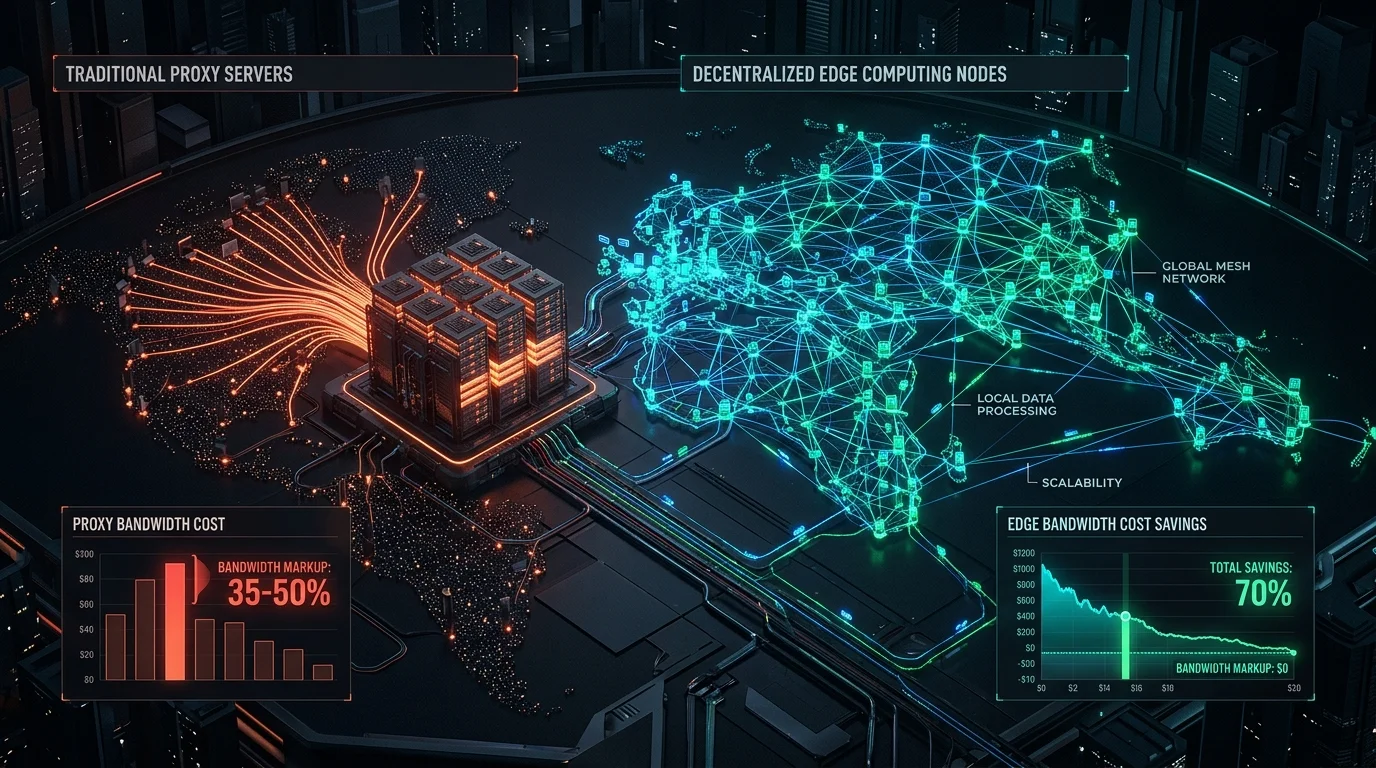
Decentralized Nodes vs Residential Proxies: The Complete Cost & Architecture Guide (2026)
2026-06-01 · 15 min read
DataDome & Kasada Anti-Bot Bypass in 2026: Complete Developer Guide
2026-05-15 · 15 min read
How to Bypass Cloudflare Turnstile in 2026: Working Playwright & Stealth Guide
2026-01-15 · 12 min readPlatform Hub
Automate Without Limits
Join thousands of developers running browser automations on their own hardware.