Decentralized Nodes vs Residential Proxies: The Complete Cost & Architecture Guide (2026)
Compare decentralized residential nodes vs proxy vendors. Learn why 4G/5G CGNAT nodes eliminate metered bandwidth fees and save up to 90%.
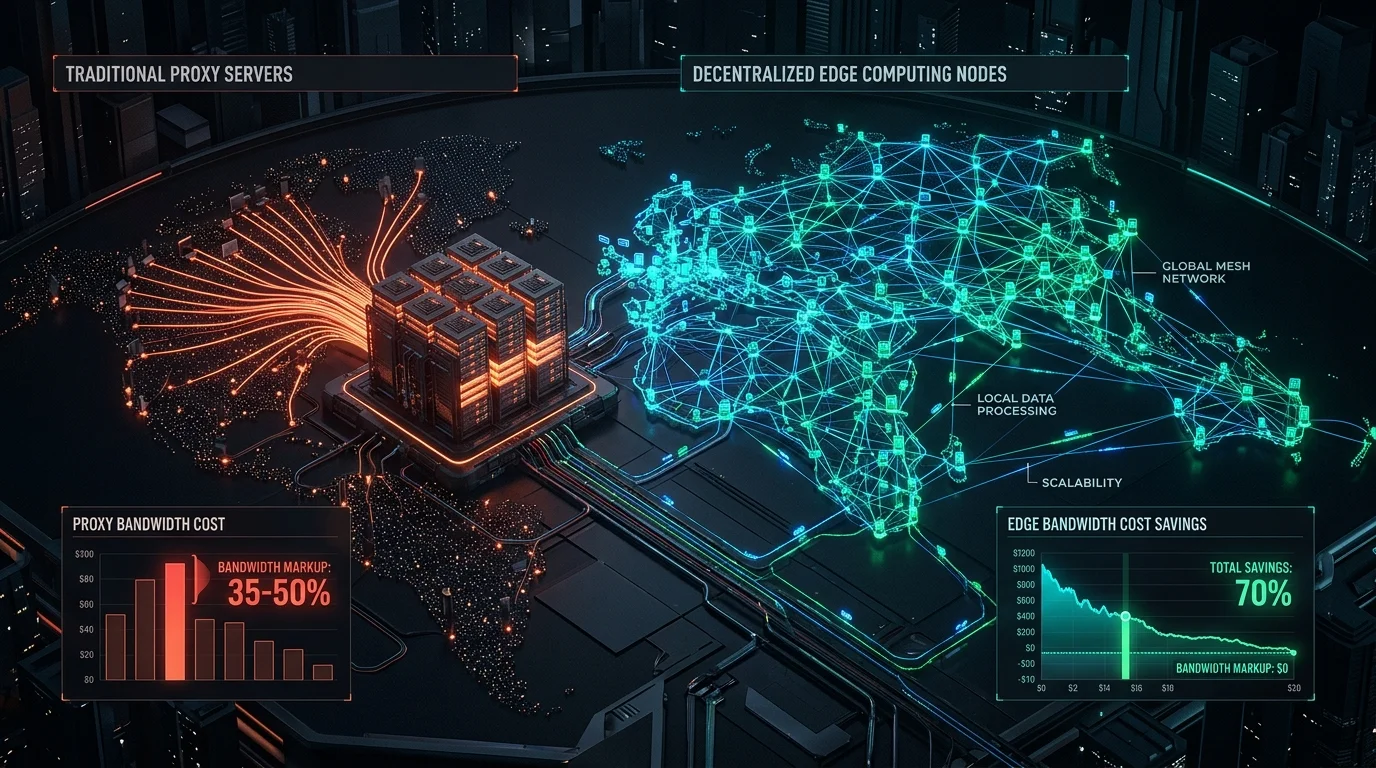
TL;DR: For years, enterprise web scraping and browser automation relied on centralized proxy brokers (Bright Data, Oxylabs, Smartproxy) charging $8.40 to $30.00+ per gigabyte for metered residential proxy bandwidth. In 2026, rich single-page applications, dynamic media hydration, and anti-bot sensor payloads cause single automated workflows to consume tens of gigabytes daily, inflating monthly bills into thousands of dollars. BrowserMesh introduces a revolutionary alternative: executing browser automation directly on your own decentralized edge devices (Windows PCs, Linux servers, and Android 4G/5G nodes), permanently reducing proxy bandwidth costs to $0/GB.
The Metered Proxy Trap: Why Traditional Residential Proxies Are Broken
When building web scrapers, price intelligence scrapers, or regression test automation suites, developers have traditionally purchased metered residential proxy access. However, three foundational flaws make this legacy model economically unsustainable in 2026:
┌─────────────────────────────────────────────────────────────────────────────┐
│                 The Hidden Cost Multipliers of Legacy Proxies               │
├─────────────────────────────────────────────────────────────────────────────┤
│ 1. Heavy DOM & Media Payloads ──► SPAs download 5MB-15MB of JS/Fonts/Assets │
│ 2. Anti-Bot Retries & Polling ──► Blocked requests still burn metered GBs   │
│ 3. 3rd-Party Data Interception──► Harvested credentials transit proxy relays │
│ 4. Shared Pool Contamination  ──► Other customers get your shared IPs banned│
└─────────────────────────────────────────────────────────────────────────────┘
1. The Dynamic Web Bandwidth Explosion
Modern web platforms no longer serve static 50KB HTML pages. A standard dynamic single-page application (React, Next.js, Angular) bundles heavy client-side JavaScript, WebGL canvas shaders, video assets, and fonts. A single Chromium page navigation consumes between 5 MB and 20 MB of data transfer.
If your scraper visits 10,000 product pages per day:
- Daily Bandwidth: $10,000 \times 10\text{ MB} = 100\text{ GB / day}$
- Monthly Bandwidth: $100\text{ GB} \times 30\text{ days} = 3,000\text{ GB / month}$
- At $15/GB (Standard Residential Proxy Tier): $45,000 / month just in bandwidth surcharges!
Detailed Cost Breakdown: Bright Data vs. Oxylabs vs. BrowserMesh
Let's examine how traditional proxy providers compare to decentralized edge execution across real-world enterprise metrics:
[!TIP] Explore Transparent Pricing: See how BrowserMesh delivers predictable flat-rate automation with 500 free monthly executions on our Transparent Pricing Plans (
/pricing).
Why 4G/5G CGNAT Mobile IPs Are Never Blacklisted
A core technical advantage of decentralized node architecture is the utilization of Carrier-Grade NAT (CGNAT) mobile network routing.
                  Thousands of Authentic Mobile Phone Users
                                     │
                                     ▼
                     ┌───────────────────────────────┐
                     │ Cellular Carrier CGNAT Gateway│
                     │  (Shared Public IPv4 Address) │
                     └───────────────┬───────────────┘
                                     │
                                     ▼
                          Target Web Application
                       (Sees Legitimate Mobile IP)
The Mathematics of CGNAT Immunity:
- Shared Public IP Addresses: Mobile telecom carriers (Verizon, AT&T, Vodafone, Jio, Airtel) assign thousands of cellular smartphones to a single shared public IPv4 address using dynamic port translation.
- The Blacklist Dilemma for Anti-Bots: If DataDome, Cloudflare, or Akamai were to ban a single cellular CGNAT IP address, they would simultaneously block hundreds or thousands of legitimate paying mobile shoppers and app users.
- Natural Mobile Fingerprints: Mobile nodes running on genuine Android hardware provide authentic battery telemetry, mobile GPU shader profiles, and authentic carrier round-trip latency.
To learn how to connect an Android mobile node, read our CGNAT Mobile Architecture Guide (/docs/cgnat-mobile).
The Architecture of Decentralized Local Edge Execution
Instead of funneling raw browser traffic through slow, high-latency proxy relay servers, BrowserMesh operates as a distributed execution mesh:
┌─────────────────────────────────────────────────────────────────────────────┐
│                    BrowserMesh Decentralized Architecture                   │
├─────────────────────────────────────────────────────────────────────────────┤
│  1. Web Studio / MCP Agent ──► Dispatches Task Manifest                     │
│  2. Local Node Manager     ──► Runs Task on Local Machine / Mobile Device   │
│  3. Native Browser Runtime ──► Uses Direct Local Wi-Fi / Fiber Connection   │
│  4. AutomationEngine Core  ──► Applies Bio-Realistic Bezier Dynamics        │
│  5. Local SQLite Storage   ──► Writes Extracted Data Directly to Disk       │
└─────────────────────────────────────────────────────────────────────────────┘
Architectural Advantages:
- Zero Latency Overhead: Requests travel directly from your local network adapter to the target server without intermediary proxy hops (reducing page load time by 40–60%).
- 100% Local Data Privacy: Authentication cookies, session tokens, passwords, and extracted records are written directly to your private local SQLite database on your own machine.
- No Cloud Grid Markup: Workflows execute on your own idle compute power (laptops, workstations, or spare Linux VPS instances).
Step-by-Step: Setting Up a Self-Hosted Residential Node Fleet
Setting up your private residential automation fleet takes less than 5 minutes:
1. Windows Desktop / Server Setup
- Desktop GUI App: Download and install
BrowserMesh-Setup-1.0.0.exefrom the Download Center. The desktop app bundles both the UI and local execution engine without browser permission prompts. - Headless Windows Server (PowerShell):
Terminal / Code
powershell -NoProfile -ExecutionPolicy Bypass -Command "iwr -useb https://www.browsermesh.in/scripts/install-headless.ps1 | iex"
2. Run Headless Daemon on Linux VPS / Raspberry Pi
For continuous 24/7 background execution on Ubuntu, Debian, CentOS, or macOS:
# 1. Install BrowserMesh Headless Daemon
curl -sSL https://www.browsermesh.in/scripts/install-headless.sh | bash

# 2. Check node health and daemon status
mesh status

# 3. Stream real-time engine logs
mesh logs
The installer configures a PM2 process supervisor automatically so your node restarts on reboots and recovers from interruptions.
3. Deploy Android Mobile Node (4G/5G Carrier Network)
Turn any Android phone (Android 10+) into a dedicated cellular automation node:
- Download
BrowserMesh-v1.0.apkfrom the Download Center. - Launch the app, grant notification and battery optimization bypass permissions.
- Tap "Start Mobile Worker". The app initializes an embedded ARM64 execution runtime running over your mobile carrier data plan.
- Your mobile node instantly appears in Web Studio under your connected device fleet.
Real-World Case Study: Saving $1,200+/Month on Large-Scale E-Commerce Scraping
A mid-sized pricing intelligence agency was monitoring 50,000 Amazon and Walmart products daily.
Before BrowserMesh (Bright Data Residential Proxies):
- Monthly Bandwidth Consumed: 180 GB
- Proxy Cost: $15.00 / GB $\times$ 180 GB = $2,700.00 / month
- Proxy Failure Rate: 14.2% (blocked IP retries consumed additional bandwidth)
- Total Infrastructure Cost: $2,700 / mo
After Switching to BrowserMesh:
- Deployed 3 local node machines (1 office workstation, 1 home fiber node, 1 Android 5G node).
- Plan: BrowserMesh Pro (₹299 / month = ~$3.50/mo)
- Proxy Bandwidth Surcharges: $0.00
- Execution Reliability: 99.4% (via AutomationEngine Bezier curves)
- Monthly Savings: $2,696.50 / month (99.8% Cost Reduction)
Conclusion & Next Steps
Centralized proxy brokers charging metered bandwidth markups are no longer the only way to scale browser automation. By pairing decentralized local hardware nodes with BrowserMesh AutomationEngine, engineering teams achieve higher reliability, complete data sovereignty, and massive cost savings.
- Get Started Free: Download Official Node Clients (
/download) - Explore Pricing: Compare Plans & Execution Limits (
/pricing) - Explore 250+ Scrapers: Workflow Marketplace Catalog (
/marketplace) - DataDome Guide: DataDome & Kasada Bypass Guide (
/blog/datadome-kasada-bypass-guide-2026) - Turnstile Guide: How to Bypass Cloudflare Turnstile (
/blog/how-to-bypass-cloudflare-turnstile-in-2026) - Mobile Node Architecture: Carrier-Grade NAT Guide (
/docs/cgnat-mobile) - Launch Web Studio: Open BrowserMesh Studio (Free Forever)
Table of Contents
7 sectionsRelated Articles

Playwright Stealth Setup for Large-Scale Scraping: Architecture & Best Practices (2026)
2026-06-15 · 16 min read
DataDome & Kasada Anti-Bot Bypass in 2026: Complete Developer Guide
2026-05-15 · 15 min read
How to Bypass Aggressive Anti-Bot Protection in 2026: Complete DataDome, Kasada, Akamai & Cloudflare Guide
2026-03-05 · 14 min read
How to Bypass Cloudflare Turnstile in 2026: Working Playwright & Stealth Guide
2026-01-15 · 12 min readPlatform Hub
Automate Without Limits
Join thousands of developers running browser automations on their own hardware.